Choosing a commercial water heater can shape a restaurant’s service speed, energy bills, and food-safety routine. The decision becomes more urgent in 2026, as operators face volatile utility prices and stricter efficiency expectations. This guide explains how to choose a water heating system for restaurants without relying on one-size-fits-all claims.
ENERGY STAR’s Restaurant Guide reports that restaurants use roughly five to seven times more energy per square foot than many other commercial buildings. It also identifies water heating as a major energy-use category, reaching about 17% of total restaurant energy consumption. Those figures make equipment selection more than a purchasing decision. It becomes an operating-cost decision. The U.S. Department of Energy recommends comparing efficiency, demand patterns, fuel type, and installation conditions. AHRI certification can also help verify published performance claims. Small details matter, including a 120°F handwashing demand, a 180°F dish machine requirement, and long pipe runs between the kitchen and heater.
Amory Lovins, a widely cited energy-efficiency expert, said, “The cheapest energy is the energy you don’t use.” That principle supports efficient systems, but it does not answer every kitchen’s needs. A tankless unit may reduce standby losses, yet struggle during simultaneous dishwashing and peak service. A storage heater may provide dependable recovery, but require valuable floor space. Restaurant operators should compare peak flow, recovery rate, incoming water temperature, venting, recirculation, maintenance access, and total lifecycle cost. No single system wins every kitchen. That assumption is tempting, but incomplete. The best 2026 choice is the system that matches actual demand, local codes, staff habits, and long-term operating reality.
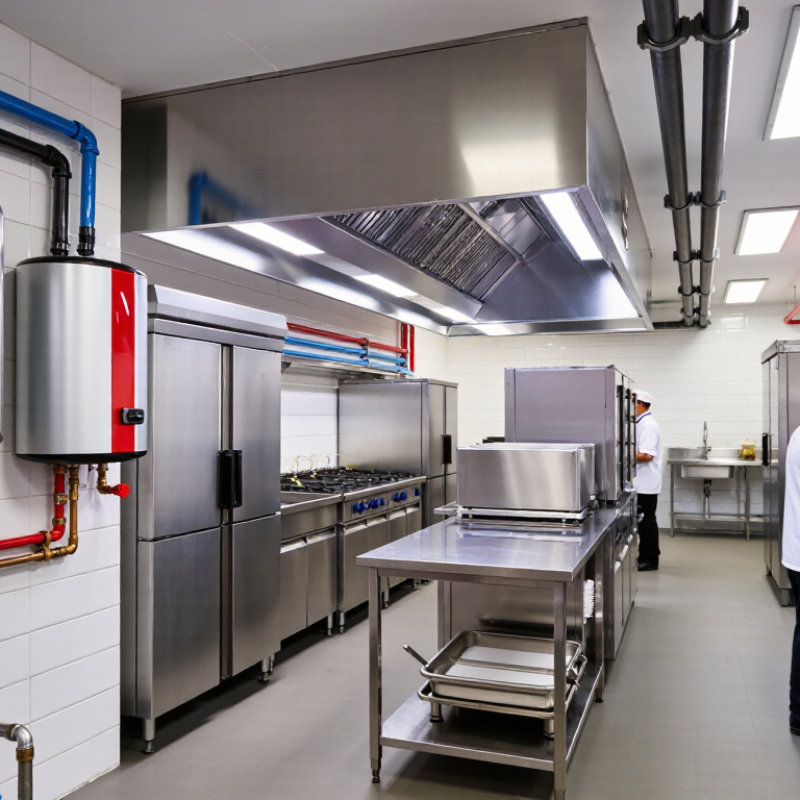
Restaurant hot water design starts with service rhythm, not tank size alone. Breakfast rushes, dishwashing waves, and closing cleanup create different demand curves. Track gallons per meal, peak-hour flow, and recovery time for two representative weeks. Peak demand matters. EPA ENERGY STAR reports that restaurants can use five to seven times more energy per square foot than other commercial buildings, making accurate load estimates important (ENERGY STAR Restaurant Guide).
Temperature targets must follow task requirements and local code. The FDA Food Code 2022 specifies at least 100°F (38°C) at handwashing facilities. For manual warewashing, it specifies a 171°F (77°C) hot-water sanitizing rinse. These are not blanket storage settings. Use thermostatic mixing valves where appropriate, and verify outlet temperatures with a calibrated thermometer. A few degrees can affect safety, comfort, and energy consumption.
Size storage for the busiest service window, then check recovery capacity between cycles. ASHRAE guidance treats fixture demand, usage patterns, and recovery rate as core sizing inputs. A 100-gallon tank may fail during a sudden dishwashing surge, while oversized storage can waste energy during quiet afternoons. A neat spreadsheet can still lie. Menu changes, added seating, or longer operating hours should trigger a fresh review. Small errors compound. Practical commissioning should compare predicted demand with meter readings, staff observations, and actual cleaning schedules.
Commercial kitchens need hot water during sharp, uneven demand peaks. Dishwashers, prep sinks, and handwashing stations may operate together. Storage-tank systems remain practical because they hold reserve water. Gas models usually recover heat quickly. Electric tanks are simpler, quieter, and easier to install. Their operating cost can rise in areas with expensive electricity.
Tankless systems heat water only when needed. They save floor space but require strong flow control and enough electrical or gas capacity. Multiple units may improve redundancy.
Heat-pump water heaters deserve attention in 2026. The U.S. Department of Energy’s Better Buildings guidance reports efficiencies roughly two to three times higher than standard electric resistance systems. However, recovery slows in cold mechanical rooms. That weakness matters during dinner service.
Indirect systems, connected to a boiler, can support large facilities, but they add design complexity. ASHRAE Handbook—HVAC Applications, 2023, stresses peak-demand analysis rather than average daily consumption.
Measure the busiest 15-minute period. Check incoming water temperature, recovery rate, and storage volume. Ask for service access around every component. A smaller tank may look efficient, yet repeated shortages can disrupt dishwashing.
I would also question optimistic savings estimates. Real results depend on insulation, recirculation losses, cleaning schedules, and local utility rates. A mixed system often works better than one oversized unit.
Energy sources shape both performance and risk. Natural gas often delivers fast recovery for busy kitchens, but ventilation and combustion maintenance add costs. Electric systems are easier to install and control, especially where gas access is limited. Heat pump water heaters can reduce energy use substantially, although they need suitable space, airflow, and backup capacity. Solar thermal may support daytime demand, but weather and roof conditions affect reliability.
Efficiency ratings deserve careful reading. Commercial buyers should compare thermal efficiency, standby loss, recovery rate, and annual energy consumption. A high efficiency percentage does not guarantee low operating costs. A restaurant serving 100 guests may need strong recovery during lunch, when dishwashers, sinks, and food preparation draw hot water together. Peak demand matters. A small storage tank can create expensive service interruptions.
I have found that operating cost estimates improve when managers record water usage, utility rates, inlet temperature, and daily operating hours. Include maintenance, pump electricity, descaling, and future replacement costs. A simple spreadsheet helps, but it can still mislead when demand changes seasonally. Heat pump systems may look attractive on paper, yet poor installation can reduce output and increase complaints. Test the actual recovery time after installation. Keep temperature controls stable. Review the numbers every six months, because yesterday’s usage pattern may no longer fit the kitchen.
Restaurant water heating in 2026 must begin with site conditions, not equipment size alone. A busy kitchen needs stable hot water during dishwashing, handwashing, and peak cooking periods. Measure demand by fixture flow rates, recovery time, and opening hours. Installation should be completed by licensed plumbing and electrical professionals. They should verify pipe sizing, isolation valves, drainage, combustion air, and electrical protection. Local building, plumbing, fire, and energy codes always control the final design. Never treat a technical chart as a substitute for inspection.
Safety depends on controlled temperature and pressure. Install tempering controls where scalding could affect staff or customers. A pressure-relief path must discharge safely, without blockage or improvised extensions. Fuel-burning systems require approved venting, adequate air, and carbon-monoxide monitoring where applicable. Electrical units need grounding, dedicated circuits, and moisture protection. Keep combustible storage away from heat sources. Small details matter. A rushed connection can become a leak, burn, or service shutdown.
Reserve enough clearance for servicing, filter cleaning, and emergency isolation. The room should have a visible drain or leak-control plan, dry access paths, and protection from grease. Technicians should inspect valves, sensors, relief devices, sediment, and scale on a documented schedule. Hard-water sites may need more frequent flushing. Record temperatures and faults, not just repairs. In practice, maintenance intervals are often guessed. That is a weakness worth correcting. I would rather allow extra service space than force a technician to work sideways behind stacked supplies.
| System Type | Typical Commercial Application | Typical Capacity or Output | Approximate Efficiency | Installation Requirements | Key Safety Standards and Controls | Maintenance Frequency | Typical Space Requirement | Main Advantages | Main Limitations |
|---|---|---|---|---|---|---|---|---|---|
| Gas-Fired Storage Tank | High-demand kitchens with simultaneous dishwashing, food preparation, and handwashing loads. | Commercial tanks commonly range from 80 to 120 gallons; input ratings often range from approximately 150,000 to 500,000 BTU/h. | Approximately 78%–96% thermal efficiency, depending on equipment design and operating conditions. | Requires a gas supply, combustion-air provision, flue or approved venting, condensate drainage for condensing models, water connections, and service clearance. | Temperature and pressure relief valve; approved gas shutoff; flame-failure protection; backflow prevention where required; installation in accordance with applicable fuel-gas, plumbing, and building codes. | Inspect burners and venting annually; flush the tank at least annually; inspect the relief valve and anode protection according to the service manual and water conditions. | Large footprint, commonly requiring about 20–45 square feet including service access, ventilation, and code clearances. | High recovery rate, familiar technology, and reliable hot-water availability for peak kitchen demand. | Combustion ventilation and exhaust are required; standby heat loss can be significant; installation may be unsuitable for poorly ventilated spaces. |
| Electric Storage Tank | Small to medium restaurants, facilities without gas service, and locations with moderate hot-water demand. | Commercial tanks commonly range from 30 to 120 gallons; electrical input is frequently approximately 6 to 54 kW, depending on tank size and recovery requirements. | Approximately 95%–99% point-of-use conversion efficiency, excluding upstream electricity-generation losses. | Requires dedicated electrical circuits, correctly sized overcurrent protection, water connections, floor drainage or leak detection, and adequate structural support for a full tank. | Temperature and pressure relief valve; high-limit cutoff; grounding and bonding; protection against scalding; compliance with applicable electrical and plumbing codes. | Inspect wiring and controls annually; flush sediment at least annually; test the relief valve carefully; replace sacrificial anodes when inspection indicates substantial depletion. | Approximately 8–30 square feet for the tank and working clearance, depending on capacity and layout. | No combustion gases, relatively simple installation, quiet operation, and flexible placement. | High peak electrical demand; recovery may be slower than gas-fired equipment at the same storage volume; tank standby losses remain. |
| Gas-Fired Condensing Tankless | Restaurants needing high continuous output while minimizing storage-tank footprint. | Individual units commonly deliver approximately 5–15 gallons per minute, with multiple units staged for larger demand. | Approximately 90%–98% thermal efficiency for condensing designs, depending on return-water temperature and flow conditions. | Requires gas piping, sealed combustion or approved combustion-air arrangements, condensate neutralization and drainage, compatible venting, water filtration where needed, and electrical power. | Flame monitoring; over-temperature protection; flow and pressure controls; temperature and pressure relief valve; approved vent materials; anti-scald mixing control where required. | Inspect and clean the heat exchanger at least annually; descale more frequently with hard water or heavy use; inspect filters, condensate drains, venting, and combustion components. | Approximately 6–20 square feet per unit or rack zone, plus access, venting, and service space. | Compact footprint, low standby loss, scalable output, and continuous hot-water production. | Higher design and installation complexity; minimum-flow requirements may affect low-demand fixtures; scaling can reduce performance. |
| Electric Tankless | Point-of-use or zone heating for handwashing stations, bar areas, and smaller food-service operations. | Common outputs range from approximately 10 to 36 kW per module; flow depends strongly on inlet temperature and required temperature rise. | Approximately 97%–99% point-of-use conversion efficiency. | Requires substantial electrical capacity, multiple dedicated circuits for larger units, correct conductor sizing, water filtration where needed, and service access. | Electronic temperature control; high-limit cutoff; grounding and bonding; temperature and pressure relief protection where required; anti-scald control for vulnerable users. | Inspect electrical connections annually; clean inlet screens; descale the heat exchanger according to water hardness, commonly every 6–12 months in demanding applications. | Approximately 2–10 square feet per module, with electrical-panel capacity and maintenance access. | Very small footprint, no combustion venting, low standby loss, and flexible zoning. | Large kitchens may require costly electrical upgrades; output falls as temperature rise increases; simultaneous peak use can exceed capacity. |
| Heat Pump Water Heater | Energy-conscious restaurants with adequate plant-room air volume and moderate-to-high daily hot-water demand. | Commercial systems commonly use storage tanks from approximately 50 to 500 gallons, often with electric resistance backup. | Typical coefficient of performance is about 2.0–4.0 under suitable conditions; actual performance varies with ambient temperature and setpoint. | Requires adequate air volume or ducting, condensate drainage, electrical service, low-temperature operating clearance, and a location that can tolerate fan noise and cool exhaust air. | Temperature and pressure relief valve; high-limit protection; condensate overflow protection; electrical grounding; mixing valve where needed; compliance with applicable commercial plumbing and electrical requirements. | Clean air filters monthly or as specified; inspect coils and condensate drains quarterly; flush the tank annually; service refrigerant components according to the maintenance manual. | Approximately 15–60 square feet, including tank clearance, airflow space, condensate drainage, and service access. | Lower energy consumption, reduced operating cost potential, and no on-site combustion. | Lower recovery at cold ambient conditions; requires more space and airflow; compressor noise and condensate management must be considered. |
| Indirect Water Heater with Boiler | Large facilities that already operate a hydronic boiler plant for space heating or process loads. | Storage capacity commonly ranges from approximately 40 to 500 gallons, with recovery determined by boiler output and heat-exchanger sizing. | System efficiency depends on boiler type and controls; high-efficiency condensing boiler systems can achieve approximately 90%–98% seasonal thermal efficiency. | Requires boiler capacity, primary and secondary piping, pumps, expansion control, storage-tank connections, drain provisions, and coordinated controls. | Temperature and pressure relief valve; low-water cutoff for the boiler; backflow protection; mixing control; expansion tank; compliance with applicable boiler, plumbing, and pressure-vessel requirements. | Service the boiler annually; inspect pumps and controls; flush the storage tank; check heat-exchanger performance and relief devices according to the service schedule. | Approximately 20–80 square feet, depending on tank size and whether the boiler plant already exists. | Efficient for integrated facilities, strong recovery potential, and centralized system management. | Higher engineering complexity; dependent on boiler availability; not economical when a boiler system is not already installed. |
Note: Capacity, efficiency, maintenance intervals, and clearances vary by design, climate, water quality, local code, and equipment configuration. Final sizing and installation should be completed by qualified licensed professionals.
Choosing a 2026 restaurant water-heating system starts with measured demand, not a showroom promise. Record peak use during opening, lunch, and closing cleanup. Note dishwashers, hand sinks, prep stations, and showers separately. Measure the peaks. A busy kitchen may need rapid recovery, while a small café may need less storage. Ask a qualified installer to check gas, electrical capacity, ventilation, drainage, and local code requirements.
Compare usable hot-water output, recovery time, standby loss, service access, and operating cost. Request test data and a written sizing calculation. Choose controls that clearly display temperature and fault status. Keep water safely regulated, with mixing protection where needed. Efficiency matters, but hygiene and repairability matter too. A powerful system becomes a poor choice if staff cannot reach filters or service panels.
Build a simple selection trial. Measure inlet temperature on a cold morning, then model the busiest 30-minute period. Allow space for seasonal changes and future menu growth. Keep it practical. Ask the installer to explain maintenance intervals in plain language. One unusually busy event can distort planning and encourage oversized equipment. That mistake is easy to repeat. Review warranty terms, response times, spare-part availability, and staff training before approval. Recheck the calculations after real usage begins.
This comparison shows typical useful-heat performance for commercial water-heating technologies. Heat-pump water heaters are displayed as COP × 100; a value of 300% represents a COP of 3.0. Actual performance depends on inlet-water temperature, demand profile, climate, ventilation, and system sizing.
Storage tanks provide reserve water for dishwashers, prep sinks, and handwashing stations. Gas models often recover quickly. Electric tanks are quieter and simpler. A mixed system may perform better than one oversized unit.
Tankless units save floor space and heat water only when needed. They need strong flow control and enough electrical or gas capacity. Multiple units can improve backup coverage. Peak service may still expose weaknesses.
They can use much less energy than standard electric resistance systems. They need airflow, suitable space, and backup capacity. Recovery may slow in a cold mechanical room. Dinner service reveals that problem quickly.
Record the busiest 15-minute period, not average daily use. Include dishwasher cycles, sink flow, handwashing, and food preparation. Check inlet temperature, storage volume, and recovery time. Average demand can mislead.
Track water use, utility rates, inlet temperature, operating hours, maintenance, and pump electricity. Include descaling and future replacement costs. Review the figures every six months. Yesterday’s usage may no longer fit.
Install temperature controls where scalding could affect workers or customers. Provide a clear pressure-relief discharge path. Fuel-burning equipment needs approved venting and adequate air. Electrical systems need grounding, dedicated circuits, and moisture protection.
Leave clear access for filters, valves, sensors, relief devices, and emergency isolation. Keep supplies away from hot equipment. Provide a visible drain or leak-control plan. A cramped room slows repairs.
Sediment, scale, insulation damage, and recirculation losses can reduce output. Hard-water sites may need more frequent flushing. Record temperatures and faults, not only completed repairs. Maintenance intervals are often guessed. That deserves correction.
Choosing the right commercial water heater is essential for restaurant efficiency, hygiene, and customer service in 2026. This guide explains how to assess hot water needs by considering kitchen size, peak demand, dishwashing volume, cleaning routines, water temperature, and recovery speed. It also compares major system types, including storage, tankless, heat pump, and hybrid solutions, while examining their suitable applications in busy commercial kitchens.
The article further explores energy sources, efficiency ratings, expected operating costs, installation conditions, safety standards, maintenance requirements, and available space. To understand how to choose a water heating system for restaurants, readers can follow a practical step-by-step process: estimate daily and peak-hour demand, select an appropriate capacity and technology, compare long-term energy and maintenance costs, confirm installation and safety requirements, and plan regular servicing. This approach helps restaurants achieve reliable hot water performance while controlling expenses and supporting efficient kitchen operations.

Coden Kitchen